Mars Landing Sites: 16 Attempts and Their Outcomes
Compare 16 Mars soft-landing attempts, their sites and outcomes. See why Mars 3, Beagle 2 and excluded impact probes need different labels.
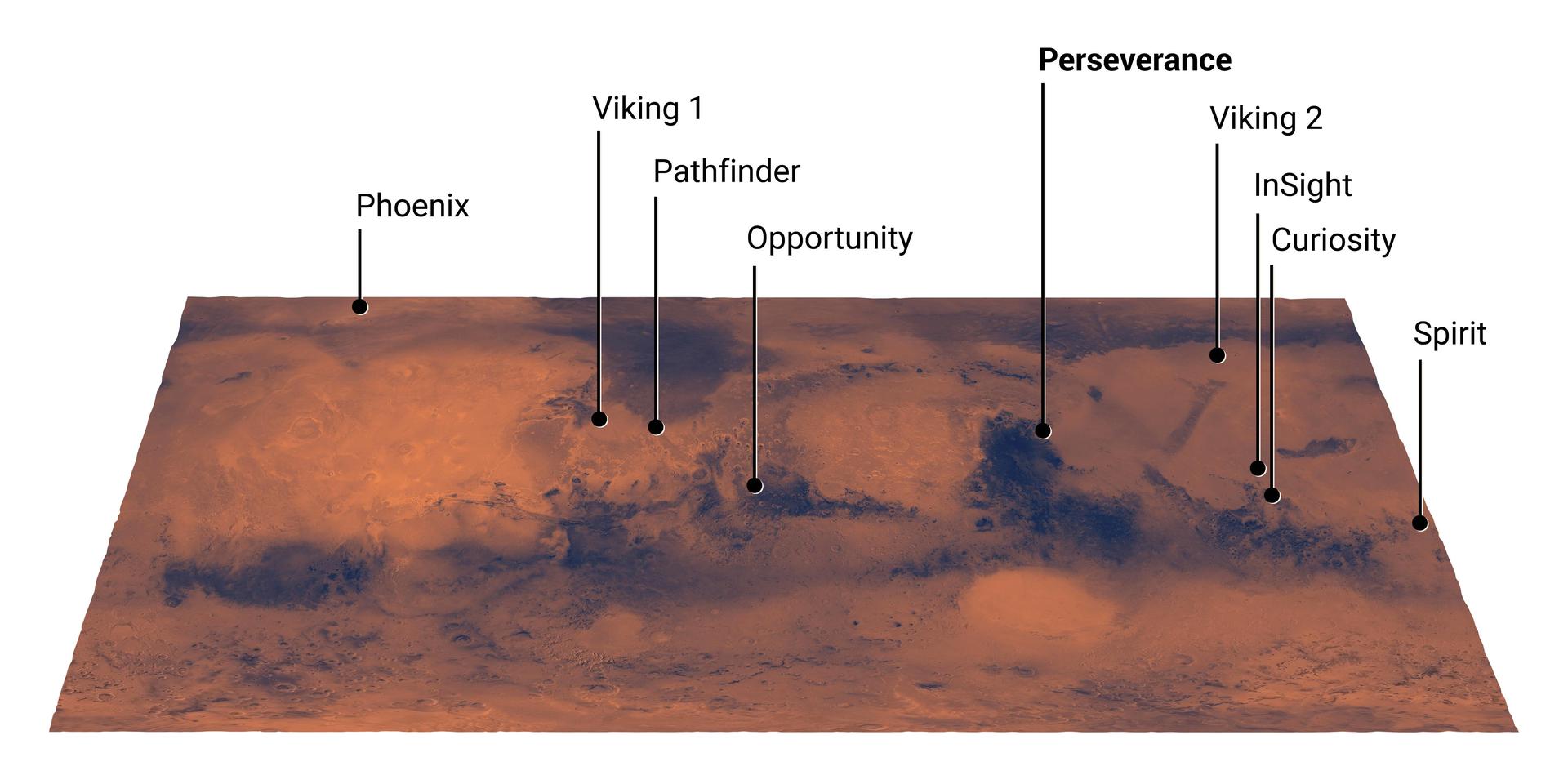
NASA’s 2020 illustration shows its landing sites, including the then-planned Perseverance site. It is not a map of all 16 attempts.
This list covers 16 full-size soft-landing systems that reached the Martian atmosphere between 1971 and 2021. Ten achieved sustained surface operations. Mars 3 transmitted only briefly; Beagle 2 landed but failed to communicate. Four other systems failed during descent. A successful touchdown, a radio signal and a successful science mission are different outcomes.
The count excludes the two Deep Space 2 impact penetrators, Mars 7 (which missed atmospheric entry), and spacecraft lost before reaching Mars. Rovers and Ingenuity are not counted again as separate arrivals from their delivery systems. The entries below give approximate coordinates where supported, and distinguish confirmed sites from predicted or unlocated ones.
Longitudes use east 0–360°: 137.44°E at Gale is the same longitude as 222.56°W. Latitude also needs a convention: historical planetographic and modern planetocentric values differ. For Viking we use NASA NSSDCA’s explicitly planetocentric coordinates; other locations are rounded mission-reference values, not a navigation dataset. Mars 3’s predicted position is labelled separately.
The complete list
In arrival order; dates are UTC. Mission names link to their dossiers where available. Coordinates describe landing locations, not the present positions of moving rovers.
Mars 2 — USSR, 27 Nov 1971. not located, region unknown. Crashed — and so became the first human-made object to reach the surface.
Mars 3 — USSR, 2 Dec 1971. Approximately 45°S, 202°E: predicted location in Ptolemaeus Crater, not a confirmed hardware position. First soft landing on Mars; JPL reports 14.5 seconds of transmission. Candidate hardware seen in orbital images remains unconfirmed in that report.
Mars 6 — USSR, 12 Mar 1974. not located, Margaritifer Terra (target). Sent data during descent, then went silent near the surface.
Viking 1 — NASA, 20 Jul 1976. 22.27°N, 312.05°E, Chryse Planitia. The first fully successful landing; it ran for six years.
Viking 2 — NASA, 3 Sep 1976. 47.64°N, 134.29°E, Utopia Planitia. The northern twin, operating for nearly four years.
Mars Pathfinder — NASA, 4 Jul 1997. 19.13°N, 326.79°E, Ares Vallis. Delivered Sojourner, the first rover to drive on Mars.
Mars Polar Lander — NASA, 3 Dec 1999. not located, south polar layered terrain (target). Lost during descent and never found.
Beagle 2 — UK-led, delivered by ESA’s Mars Express, 25 Dec 2003. 11.53°N, 90.43°E, Isidis Planitia. Landed successfully but did not fully deploy or communicate; identified in orbital images in 2015.
Spirit — NASA, 4 Jan 2004. 14.57°S, 175.48°E, Gusev Crater. Drove 7.7 km and found mineral evidence of ancient hot water.
Opportunity — NASA, 25 Jan 2004. 1.95°S, 354.47°E, Meridiani Planum. Drove 45 km across fourteen years, on a 90-sol primary mission.
Phoenix — NASA, 25 May 2008. 68.22°N, 234.25°E, Vastitas Borealis. Dug down and touched water ice a few centimetres below the surface.
Curiosity — NASA, 6 Aug 2012. 4.59°S, 137.44°E, Gale Crater. Still working, reading a long-lived lake bed layer by layer.
Schiaparelli — ESA, 19 Oct 2016. impact site imaged, Meridiani Planum. Crashed; the wreckage was photographed from orbit soon afterwards.
InSight — NASA, 26 Nov 2018. 4.50°N, 135.62°E, Elysium Planitia. Measured marsquakes and mapped the crust, mantle and core.
Perseverance — NASA, 18 Feb 2021. 18.44°N, 77.45°E, Jezero Crater. Collects rock and regolith samples for possible future return to Earth. It carried Ingenuity, whose flight mission ended in 2024.
Zhurong — CNSA, 14 May 2021. 25.07°N, 109.93°E, Utopia Planitia. The first CNSA rover, successful on the agency’s first landing attempt; hibernating since May 2022 and not heard from since.
Three of those vehicles were carried by another: Sojourner rode down inside Pathfinder, Ingenuity under Perseverance, and Zhurong on the Tianwen-1 lander. They are listed under the spacecraft that delivered them, because that is where the coordinate belongs.
Which sites are confirmed, and which are estimates?
A dot needs an uncertainty label. Mars 2, Mars 6 and Mars Polar Lander have predicted arrival areas, but no confirmed hardware positions in the sources used here. Mars 3 is a fourth caution: the commonly quoted 45°S, 202°E is a predicted position, and JPL’s 2013 report described possible hardware rather than a confirmed identification. A target or estimate must not be presented as a surveyed landing point.
Beagle 2 shows why landing and mission outcomes must be separate. ESA’s 16 January 2015 report identified the partially deployed lander at Isidis Planitia and concluded that entry, descent and landing had worked. Incomplete solar-panel deployment probably blocked the antenna; no surface data arrived. Schiaparelli was a crash, but orbital imaging located its impact site in Meridiani Planum after the 2016 descent.
That distinction — targeted versus located — is why counting Mars landings is harder than it looks, and why two reputable sources can print different totals for the same list.
What the landings actually established
Read in order, the list is not sixteen isolated events. It is four questions, each one opened by the answer to the last.
Can you get down at all? (1971–1976) Mars 2 and Mars 3 arrived during a planet-encircling dust storm, but the cause of Mars 3’s silence remains uncertain. It achieved the first soft landing on Mars and transmitted for 14.5 seconds according to JPL. Viking 1 and Viking 2 then demonstrated sustained surface science, operating for six years and nearly four years respectively.
Can you move? (1997–2004) Pathfinder’s Sojourner was the size of a microwave oven and drove about a hundred metres, which was the entire point: it showed that a rover could survive landing and then choose where to look. Spirit and Opportunity turned that demonstration into a method. Both were built for 90 sols. Spirit lasted six years and found mineral evidence of ancient hot water; Opportunity lasted fourteen and drove 45 kilometres, a distance nobody designing it would have promised.
Is there water? (2008–2012) Phoenix landed far north specifically to dig, and found water ice a few centimetres down — not inferred from orbit, but scraped and photographed. Curiosity then landed in Gale Crater to read the geological record rather than sample the present, working through a stack of sediments deposited in a long-lived lake.
What is inside Mars, and which samples should come home? (2018 onward) InSight used marsquakes to constrain the crust, mantle and core. Perseverance collects samples from Jezero’s crater floor, delta and other geological units for a possible future return; a sample is not proof of life. Zhurong made China the second country to operate a rover on Mars. CNSA reported 1,921 metres travelled after 347 Martian days as of 5 May 2022. It entered hibernation later that month; NASA’s Mars24 record notes the failed contact attempts announced in April 2023 and dust as the likely power problem.
Why low latitudes and low elevations are often favoured
Most sustained surface missions landed near the equator, but Viking 2 at roughly 48°N and Phoenix at 68°N are clear exceptions. Mars 3’s brief transmission came from an estimated site near 45°S. Low elevation provides more atmosphere for braking; gentle slopes and few large rocks reduce different landing hazards. Flat ground is not necessarily rock-free: Viking 2’s photographs show a rocky surface. Site limits depend on each vehicle and its power system.
Those constraints tighten again for a crewed mission, which needs accessible water ice as well — and ice pushes the target north, away from the equatorial comfort zone. We work through that trade-off, and the shortlist it produces, in where the first Mars colony would land.
One site chosen, not yet flown
Oxia Planum — 18.28°N, 335.37°E. The landing region selected for ESA’s Rosalind Franklin rover, picked for clay-rich terrain that formed in water. After years in which the launch date moved repeatedly, the mission finally has a target: NASA’s ROSA project is supplying the launch service along with the lander’s braking engines, radioisotope heater units and a mass spectrometer, it has selected a SpaceX Falcon Heavy from Launch Complex 39A, and it is targeting a launch no earlier than late 2028 — a window that would put the rover on the surface in 2030.
The 2030 arrival is not our calculation: ESA’s published mission FAQ describes a two-year transfer from the 2028 opportunity and a planned landing in 2030, timed for favourable surface conditions. NASA’s 16 April 2026 update says launch no earlier than late 2028. Both are plans, not completed events. Oxia’s quoted coordinate is a regional reference point, not a confirmed future touchdown position.
FAQ
How many Mars landings have there been?
Our defined set contains 16 full-size soft-landing systems that reached the atmosphere. Add the two Deep Space 2 impact penetrators and the count becomes 18 individual entry vehicles. Mars 7 adds another attempted landing mission but not an atmospheric entry: it missed Mars. Counting launch failures or separating rovers from their landers answers a different question.
How many Mars landings were successful?
Ten achieved sustained surface operations: Viking 1, Viking 2, Pathfinder, Spirit, Opportunity, Phoenix, Curiosity, InSight, Perseverance and Tianwen-1/Zhurong. Mars 3 briefly transmitted after a soft landing but returned no useful surface science. Beagle 2 also landed, but incomplete deployment prevented communication. Mars 2, Mars 6, Mars Polar Lander and Schiaparelli failed during descent. This avoids turning twelve soft touchdowns into twelve successful science missions.
Where is the best place to land on Mars?
For robots it has been the low equatorial plains and the craters that hold a readable geological record — which is why Gale and Jezero were chosen over more dramatic terrain. For people the answer shifts north, because the deciding factor stops being science and becomes accessible water ice.
Which year will humans land on Mars?
No crewed landing date is confirmed by anyone. SpaceX has stated an intention to send uncrewed Starships during a transfer window, and those windows open only about every 26 months, so missing one costs more than two years. Treat any specific year you see as a target rather than a schedule.
Why is Mars so hard to land on?
Mars has enough atmosphere to require heat protection, but too little to stop a lander with a parachute alone. Parachutes still remove substantial speed; rockets, airbags or a powered descent stage then handle the final phase, depending on the vehicle. The sequence runs autonomously because radio signals take minutes to cross the distance to Earth.
Sources
The historical record below is grounded in NASA’s mission chronology and Mars24 notes, the NSSDCA Viking coordinate reference, JPL’s qualified Mars 3 report and ESA’s Beagle 2 investigation. The linked mission dossiers and interactive map provide further context. Correction review: 8 November 2026; original publication dates are retained. Interactive Mars map.

Was this useful?
Choose 1 (not useful) to 5 (very useful), then save. One rating per browser identity; you can change or remove it.
No ratings yet.
Rating distribution
- 5 out of 50
- 4 out of 50
- 3 out of 50
- 2 out of 50
- 1 out of 50
Loading ratings…