01The quick answer
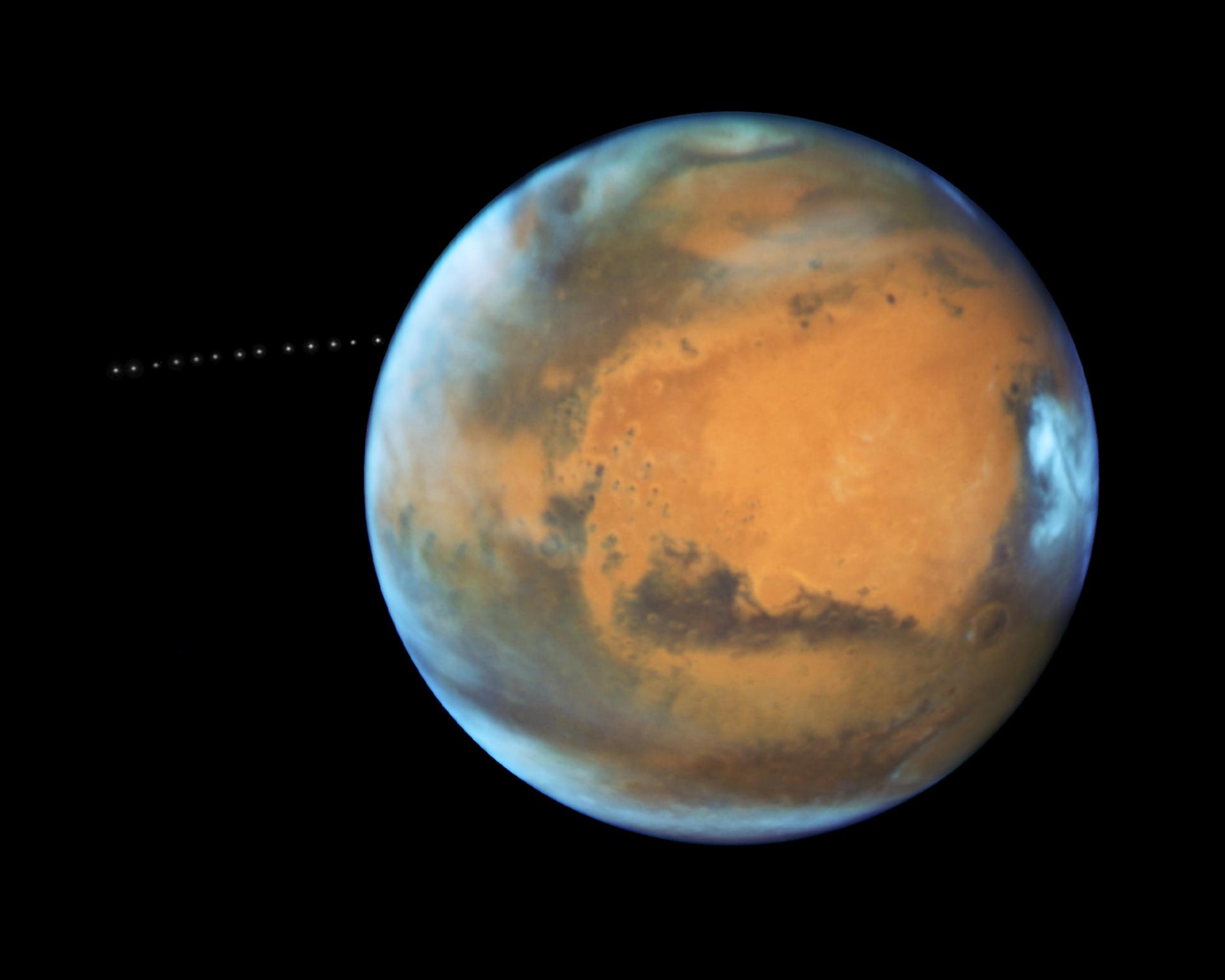
A crewed trip to Mars typically takes about seven months — roughly six to nine, depending on where Earth and Mars sit in their orbits when you leave. That is the transit time along a fuel-efficient transfer orbit, the path robotic missions have flown for decades and the one crewed missions are being designed around.
The number swings for two reasons: the huge, changing distance between the planets, and the fact that you cannot launch whenever you like. A good window opens only about every 26 months, which is why real Mars departures cluster tightly around a handful of dates each decade.
02Why it takes months, not days
You cannot fly straight to Mars. Both planets are moving around the Sun, and a spacecraft leaving Earth is already travelling at Earth’s orbital speed. To reach Mars you nudge that orbit outward and let the Sun’s gravity do most of the work — you coast along a long, curving arc that meets Mars where it will be by the time you arrive, not where it is at launch.
The standard route is a Hohmann transfer — the minimum-energy elliptical orbit that just touches Earth’s orbit at one end and Mars’ orbit at the other. A classic Hohmann transfer to Mars takes about 8.5 to 9 months (roughly 259 days). It is slow, but it is cheap: it asks the least possible propellant, and propellant is the single hardest thing to carry across interplanetary space.
Going faster is possible in principle, but the cost climbs steeply. A more direct, higher-energy trajectory shaves weeks off the trip only in exchange for a lot more propellant at launch and a harder, faster arrival that needs even more fuel to brake into orbit. With chemical rockets, that trade-off is what keeps human plans anchored near the six-to-nine-month range.
03Launch windows: why every ~26 months
A transfer orbit only works if Mars arrives at the meeting point at the same moment your spacecraft does. Because Earth laps Mars around the Sun, the two planets return to the right relative position only about every 26 months — the Earth–Mars synodic period of roughly 780 days (about 2.14 years). Miss the window and you wait more than two years for the next one.
Why the planets have to "line up"
The spacecraft is launched to arrive at a specific spot on Mars’ orbit months later. For that to work, Mars must be positioned so it sweeps into that spot exactly when the craft gets there. That geometry only repeats once per synodic period, so every real Mars mission of the past decade launched within a few weeks of the same seasonal window.
04How far Mars actually is
Mars is a moving target, and the gap between it and Earth changes enormously through the years. At its theoretical closest the two planets come within about 54.6 million km; in practice real close approaches fall around 56–58 million km, and the record-close pass of 2003 was about 55.76 million km. On average the planets sit roughly 225 million km apart, and at their most distant — on opposite sides of the Sun — up to about 401 million km.
That range is why a radio signal — which travels at the speed of light — takes anywhere from about 3 minutes each way at closest approach to about 22 minutes when Mars is far. The distance also shapes launch planning: mission designers do not aim for the day the planets are closest, but for the window where the transfer orbit is most efficient.
05How long real missions took
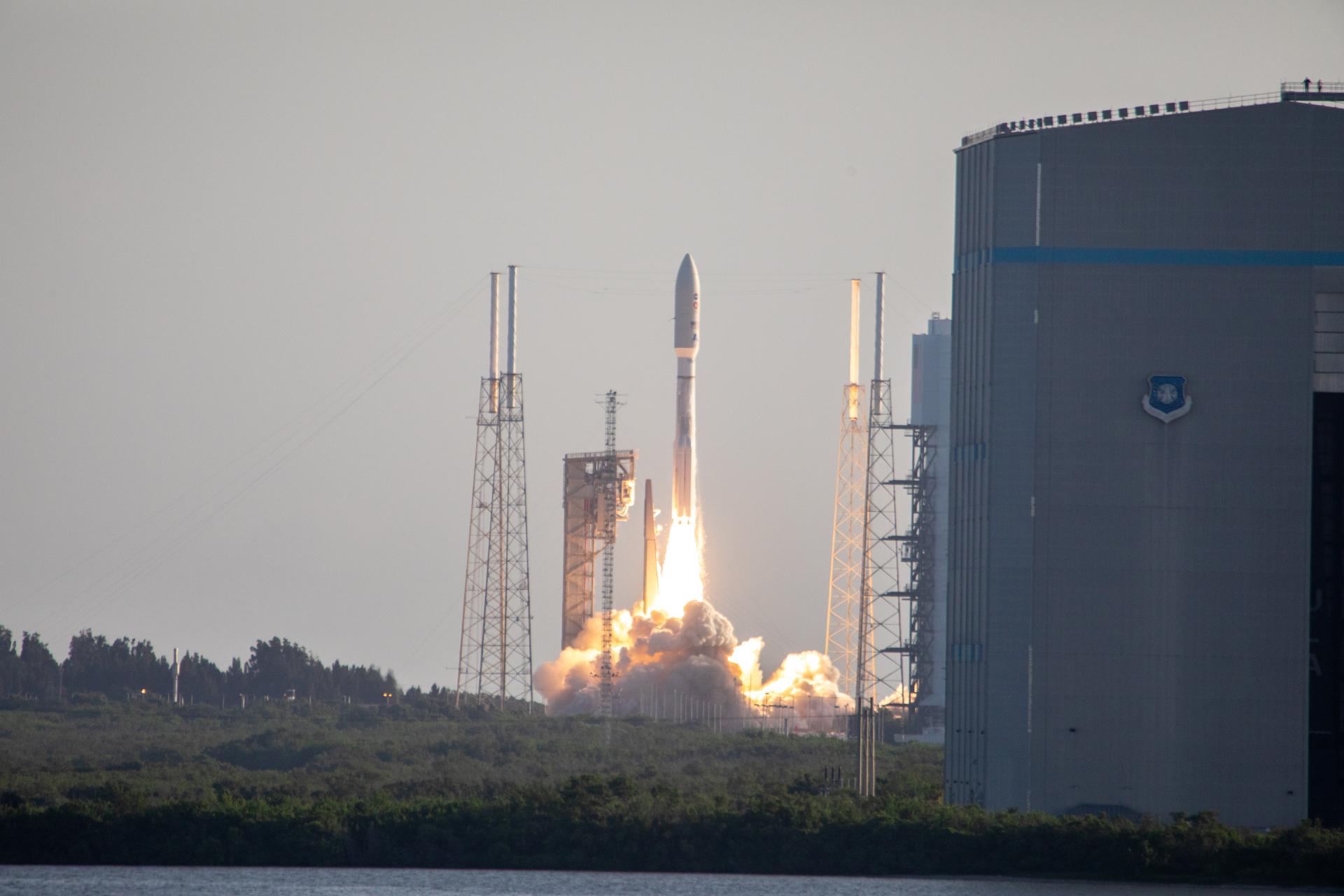
The best answer to "how long" is the record of missions that actually made the trip. Recent landers and orbiters have taken between about six and eight and a half months — comfortably inside the six-to-nine-month band, and a good guide for what a crewed transit would look like.
| Mission | Launched | Arrived | Transit |
|---|---|---|---|
| Curiosity | 26 Nov 2011 | landed 6 Aug 2012 | ~254 days (~8.5 mo) |
| InSight | 5 May 2018 | landed 26 Nov 2018 | ~205 days (~6.5 mo) |
| Perseverance | 30 Jul 2020 | landed 18 Feb 2021 | ~203 days (~6.5 mo) |
| Tianwen-1 (China) | 23 Jul 2020 | Mars orbit 10 Feb 2021 | ~202 days to orbit |
| Hope (Emirates Mars Mission) | 19 Jul 2020 | Mars orbit 9 Feb 2021 | ~205 days |
Notice how Perseverance, Tianwen-1 and Hope all launched within about eleven days of each other in July 2020 and all reached Mars in February 2021 — a textbook illustration of everyone crowding into the same launch window.
06Could we ever go faster?
Chemical rockets are near their practical limit for Mars, so the push for a shorter trip is really a push for a different kind of engine. Several are in development or on the drawing board — each promising to trim the transit, and each with a very different level of maturity.
- Nuclear thermal propulsion (NTP). By heating propellant with a reactor, NTP could roughly double the efficiency of chemical rockets and cut the transit toward about four months or less. NASA and DARPA are jointly developing a demonstration engine, DRACO, to test the concept in space.
- Nuclear-electric propulsion. A reactor powers electric thrusters that push gently but for months on end — another route to faster, more flexible interplanetary travel, though it accelerates far more slowly than NTP.
- SpaceX Starship. Starship targets a Mars transit of around six months, with aspirations to go faster if it can carry more propellant or fly a higher-energy trajectory. Those shorter times are unproven — the vehicle is still in flight testing.
Days to Mars? Only for tiny probes — for now
Speculative directed-energy concepts — ground-based lasers pushing ultra-light sails, such as the work of physicist Philip Lubin — propose reaching Mars in days or weeks. But those schemes only work for gram- to kilogram-scale uncrewed probes, not for a ship carrying people, life support and return fuel. Treat any "Mars in a month" headline as speculative and read the small print.
07The communication delay
The same distance that stretches the journey also stretches every message. A radio signal takes from about 3 minutes each way at closest approach to about 22 minutes when Mars is far — so a simple question and answer can take the better part of an hour. Real-time conversation with Earth is impossible.
That is why crews and rovers on Mars have to be highly autonomous. Landing sequences, hazard avoidance and day-to-day decisions cannot wait for a round-trip to mission control — they have to be handled on the spot, by the crew or by onboard software.
08What the journey is like for the crew
For a human crew, the length of the trip is not just a schedule — it is the central health challenge. Half a year or more in deep space stacks up several hard problems at once, all of which have to be managed the entire way there and back.
- Microgravity. Months of weightlessness during the cruise cause bone density loss and muscle wasting, countered with hours of daily exercise and, in some concepts, artificial gravity.
- Radiation. Away from Earth’s magnetic field, the crew is exposed to cosmic rays and solar particles for the whole transit — one of the mission’s biggest medical risks.
- Isolation and confinement. A small crew locked in a small volume for months, unable to talk to Earth in real time, makes mental health a first-order concern.
- Closed-loop life support. Air, water and waste must be recycled continuously the whole way — there is no resupply and no quick return.
09Frequently asked questions
How long does it take to get to Mars on average?
About seven months on a typical transfer orbit, and roughly six to nine months depending on how Earth and Mars are aligned when you launch.
Why can’t we just fly straight to Mars?
Both planets orbit the Sun, so a spacecraft has to fly a curving transfer orbit that meets Mars where it will be on arrival. A straight-line dash is not only impossible with today’s engines — it would also demand far more propellant.
What is the shortest possible trip to Mars?
With chemical rockets, a fast trajectory can trim the trip only a little below six months at a steep propellant cost. Nuclear thermal propulsion could aim for around four months or less, but no crewed vehicle has flown that fast yet.
How far away is Mars right now?
It changes constantly — from about 54.6 million km at closest approach to as much as about 401 million km when the planets are on opposite sides of the Sun, averaging roughly 225 million km. Our Tools page shows the live distance and signal delay.
Why does a launch window open only every 26 months?
Because Earth and Mars return to the right relative position for a fuel-efficient transfer only about once per synodic period — roughly 780 days, or about 2.14 years.
How long did Perseverance and Curiosity take?
Perseverance launched on 30 July 2020 and landed on 18 February 2021 — about 203 days (~6.5 months). Curiosity launched on 26 November 2011 and landed on 6 August 2012 — about 254 days (~8.5 months).
Can we get to Mars in weeks or days?
Not with crewed spacecraft. Days-to-weeks concepts rely on laser-pushed light sails and only work for tiny uncrewed probes weighing grams to kilograms — not a ship carrying people, life support and return fuel. They remain speculative.
How long is a round trip to Mars?
A round trip is dominated by the wait on Mars, not the flying. After a ~6–9 month transit you must stay on the surface until the return window opens — about 26 months later — for a total of roughly 2.5 to 3 years.
Why is the radio signal to Mars delayed?
Radio travels at the speed of light, but Mars is so far that even light needs about 3 minutes each way at closest approach and up to about 22 minutes when Mars is distant — so real-time conversation is impossible.
Does SpaceX Starship make the trip faster?
Starship targets a Mars transit of around six months, and aspires to go faster with more propellant or a higher-energy trajectory. Those shorter times are unproven — Starship is still in flight testing.
Is the trip to Mars dangerous?
Yes. Months in microgravity weaken bone and muscle, deep-space radiation is a serious medical risk, life support has no backup, and the communication delay rules out quick help from Earth — so crews must be highly autonomous.
Could future engines really cut the trip to four months?
Possibly. Nuclear thermal propulsion is about twice as efficient as chemical rockets and could aim for roughly four months or less. NASA and DARPA are building a demonstrator, DRACO, to test it in space — but it has not flown yet.
Why do all the Mars missions launch around the same time?
They all chase the same launch window. In July 2020, for example, Perseverance, Tianwen-1 and Hope all departed within about eleven days of each other and reached Mars in February 2021.